
Free Kindergarten Math Worksheets: Add & Subtract
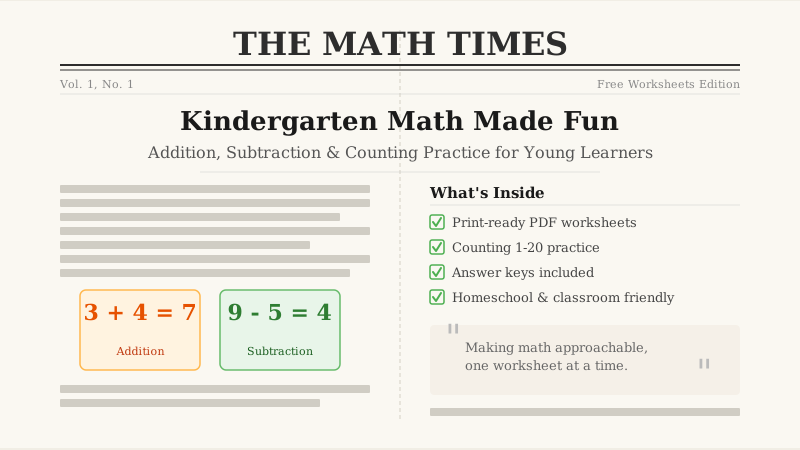
Download free kindergarten math worksheets covering addition and subtraction within 20, counting practice, and number formation. Print-ready PDFs designed for homeschool families.
By Practically School
Kindergarten math covers counting to 20, basic addition and subtraction, comparing groups, and recognizing shapes. Our free worksheets use big fonts, themed illustrations, and a 9-week progression that builds from counting to writing number sentences.
Last fall, my kindergartener sat at the kitchen table with a worksheet I’d found online and just… stared at it. Twelve tiny addition problems crammed onto one page, no pictures, font size maybe 10pt. She looked up at me and said, “Mommy, I don’t like math.”
She was five. She didn’t dislike math — she disliked that worksheet.
That moment stuck with me. I spent the next few weeks digging through Pinterest boards, Teachers Pay Teachers, and every “free printable” site I could find. Some were beautiful but cost $8 per pack. Others were free but clearly designed for first or second graders. And the ones that were actually kindergarten-appropriate? Three of them. Behind an email wall.
That’s honestly why we started making our own.
What Does Kindergarten Math Actually Look Like?
If you’re new to homeschooling (or just starting K), the scope of kindergarten math is smaller than you’d think. By the end of the year, your kid should be getting comfortable with:
- Counting to 20 reliably, and ideally skip-counting to 100 by tens
- Writing numbers 0 through 20 (this is harder than it sounds — have you seen a five-year-old try to write an “8”?)
- Adding and subtracting small numbers — think 3 + 2 or 5 - 1, usually with pictures to count
- Comparing groups — “which plate has more crackers?” is literally a math standard
- Recognizing shapes — not just naming them, but finding them in the real world
That’s it. No multiplication tables. No borrowing. No timed tests. If your kindergartener can count a pile of blocks and tell you how many are left when you take some away, they’re doing great.
The tricky part isn’t the content — it’s the delivery. A worksheet with 15 problems and no pictures is going to bomb. Two or three problems per page with big friendly farm animals? That’s a different story entirely.
What We Made (and Why It’s Free)
Our Addition & Subtraction Within 20 pack came out of those frustrating searches. Here’s what’s different about it:
It’s actually designed for kindergarteners. Huge fonts. Two to three problems per page, max. Every problem has a visual model — count the chickens, count the eggs, write the number. No abstract number sentences until they’re ready.
It’s themed. Our first set uses a farm theme — cows, chickens, tractors, the whole deal. My kids would fight over who got to do the “cow page” first. Sounds silly, but when a worksheet feels like a game instead of a chore, you don’t have to battle anyone to the table.
It builds over 9 weeks. Week 1 is just counting and number recognition. By Week 4, they’re adding with pictures. By Week 8, they’re writing simple number sentences. The progression follows Bloom’s taxonomy (fancy education speak for “we start easy and build up”), but you don’t need to know that — just print the next week’s pages when your kid is ready.
What Actually Works at the Kitchen Table
I’ve tried a lot of approaches. Here’s what I keep coming back to:
Ten minutes, then stop. Seriously. If your kindergartener is focused for ten minutes, that’s a win. Fifteen is a bonus. If they’re squirming at minute six, put the pencil down and go play. You’ll get further with four good minutes than twenty frustrated ones.
Use stuff from around the house. Before we even touch a worksheet, we count things. Goldfish crackers are the best math manipulative ever invented. “You have 5 goldfish. Eat 2. How many are left?” Boom — subtraction, and they’re thrilled about it. Buttons, LEGO bricks, dry pasta — anything small and grabbable works.
Let them use the worksheet however they want. My son colors every animal on the page before he counts them. It takes forever. But he’s engaged and he gets the right answers, so who cares? If your kid wants to circle the answers in purple crayon instead of writing the number, let them.
Repeat pages without making it weird. If your child breezes through a page, great — move on. If they struggle, just print it again next week. Don’t say “let’s try this one again.” Say “oh hey, I printed the chicken page — want to do it?” They won’t remember it’s the same one. And if they do, the confidence boost of getting it right the second time is worth it.
It’s Not Just Math, Though
One thing I didn’t expect: the fine motor practice from math worksheets carries over everywhere. Writing a “3” and writing a lowercase “e” use the same hand muscles. So if your kid is also working on letter tracing, you’ll notice the math pages get neater as their handwriting improves (and vice versa).
We also found that mixing subjects keeps things fresh. A few minutes of math, then switch to a CVC word families page, then maybe a coloring break. The variety keeps the energy up way better than 30 straight minutes of one thing.
Grab the Worksheets
Everything on our Free Downloads page is exactly that — free. No email required for the starter packs. Just download the PDF, print on regular letter paper, and you’re set.
If your kindergartener ends up loving the farm pages as much as mine did, we’ve got more themes coming (ocean, space, and jungle are in the works). Each one follows the same 9-week progression so you can swap themes without losing the structure.
And if you find a typo or your kid spots a chicken with the wrong number of legs — let us know. We actually fix those.
Frequently Asked Questions
What math should a kindergartener know by the end of the year?
By the end of kindergarten, kids should count to 20, write numbers 0-20, add and subtract small numbers (usually with pictures), compare groups, and recognize basic shapes. Skip-counting to 100 by tens is a bonus.
How long should a kindergartener do math worksheets?
Ten minutes is plenty. If they're focused for 15 minutes, that's a bonus. Four engaged minutes beats twenty frustrated ones — put the pencil down and come back tomorrow.
Are these worksheets aligned to Common Core?
Yes. The Addition & Subtraction Within 20 pack covers K.OA.A.1 through K.OA.A.5 and K.NBT.A.1, progressing from counting and number recognition through writing number sentences.
Do I need to sign up to download the worksheets?
No. The starter packs are completely free with no email required. Just download the PDF and print on regular letter paper.
What if my kindergartener struggles with a worksheet?
Just print the same page again next week without making it a big deal. The confidence boost of getting it right the second time is worth it. Use physical objects like goldfish crackers or buttons before going back to the worksheet.